🎮️ Github | 🤗 Hugging Face | 🤖 ModelScope | 📑 Home Page | 📙 Paper
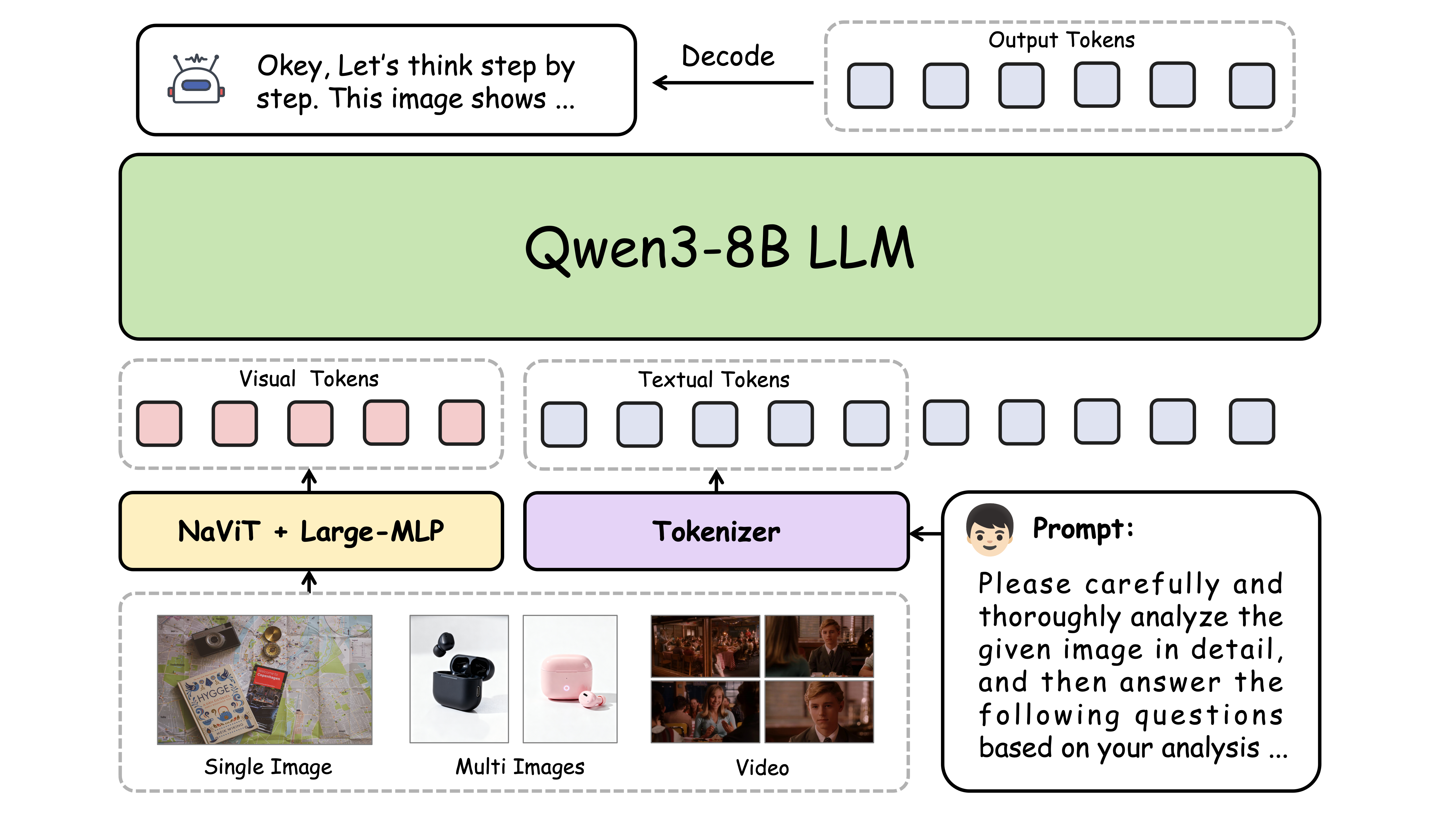
## Introduction Valley is a cutting-edge multimodal large model designed to handle a variety of tasks involving text, images, and video data, which is developed by ByteDance. Our model - Achieved the best results in the inhouse e-commerce and short-video benchmarks, much better then other SOTA opensource models. - Demonstrated comparatively outstanding performance in the OpenCompass Benchmark. ## Release - [2025/11/27] 🔥🔥🔥 We have released the technical report of Valley2.5! Check out the full paper here: [Valley2.5 Technical Report](https://raw.githubusercontent.com/bytedance/Valley/refs/heads/main/docs/Valley2_5_Tech_Report.pdf). - [2025/10/26] 🔥🔥🔥 Update [Valley2.5](https://huggingface.co/bytedance-research/Valley2.5), significantly enhance multimodal understanding and reasoning capabilities, achieving 74.3 on OpenCompass Multi-modal Academic Leaderboard! - [2025/02/15] 🔥 Update [Valley2-DPO](https://huggingface.co/bytedance-research/Valley2-DPO), achieve 69.6 on OpenCompass Multi-modal Academic Leaderboard and update AutoModel usage for checkpoints. - [2025/01/13] 🔥 Release TechReport. [Valley2: Exploring Multimodal Models with Scalable Vision-Language Design](https://arxiv.org/abs/2501.05901) - [2024/12/23] 🔥 Announcing [Valley2](https://huggingface.co/bytedance-research/Valley-Eagle-7B) (Valley-Eagle-7B)! ## Architecture For the LLM, we select Qwen3-8B-Base, chosen for its strong reasoning and language comprehension abilities. The Vision Encoder leverages Qwen2-VL-ViT, capable of processing dynamic-resolution inputs—a more robust alternative to the commonly used tiling approach when dealing with images of extreme aspect ratios. The Projector employs a 2×2 pixelshuffle downsampling on visual tokens, followed by a two-layer MLP with a 64k hidden dimension, providing high alignment capacity between modalities. This architectural design ensures that Valley2.5 achieves a balanced trade-off between representational power, computational efficiency, and multimodal adaptability. The overall architecture is shown as follows: