

DART: A Degradation-Aware Recurrent Transformer for Archival Film Restoration
Paper • 2607.21219 • Published • 1
ACCV 2026 · Mikołaj Jastrzębski, Wojciech Kozłowski, Kamil Adamczewski · Wrocław University of Science and Technology
Paper (arXiv:2607.21219) · Code · Project page · AbsoluteDegradation pipeline and benchmark · Datasets (Kaggle)
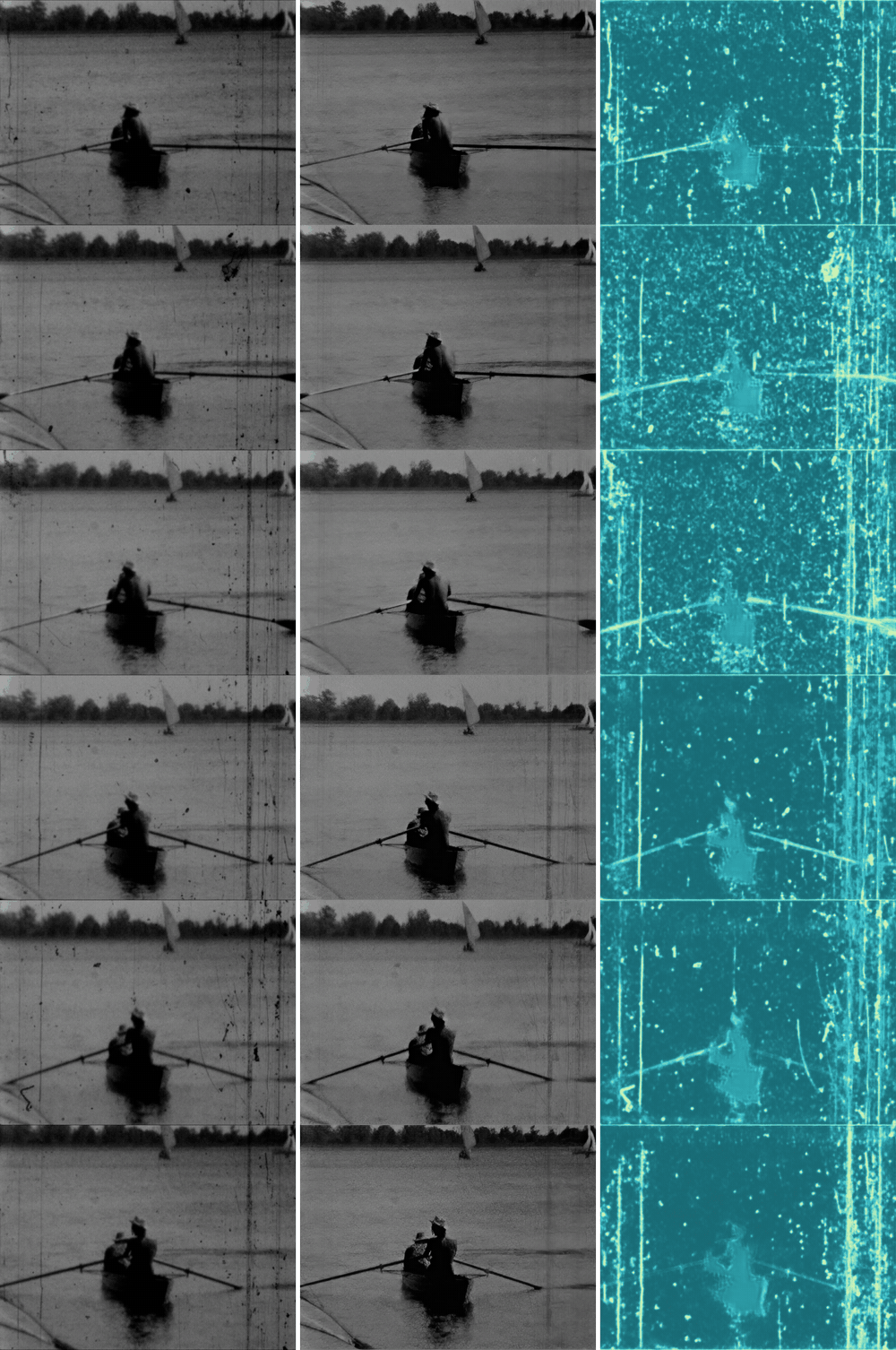
Real archival footage → DART restoration → predicted soft defect mask (bright = damaged).
Pretrained weights of DART, the model reported as "DART (Ours)" in Tables 2–4 of the paper. Archival film carries compound damage (scratches, dust, blur, noise, flicker, photometric aging) and has no clean reference. DART predicts a continuous defect mask under direct supervision, propagates it through time, and uses it both to gate temporal fusion and to condition the restoration backbone on how damaged each frame is.
| File | Format | SHA-256 |
|---|---|---|
dart.safetensors |
safetensors, fp32 | d78a388c76ffb2d71cd0fee55f44e3dde695112a40c540a7b67cc0590cfa73d3 |
dart.pth |
PyTorch state dict, fp32 | dcdb10f4a9b047af557eb415a6999c9ea0258c252807c18e368e5a2100926010 |
Both files hold the same state dict of the DART network (VideoBackbone, 423 tensors). The training discriminator and optimizer state are not included. The bundled RAFT weights are identical to the official raft-sintel.pth.
git clone https://github.com/TytanMikJas/DART-Degradation-Aware-Recurrent-Transformer.git DART && cd DART
uv sync
uv run python scripts/download_weights.py      # GitHub release, falls back to this repository

# Restore a video file or a folder of frames
uv run python scripts/inference.py --input my_clip.mp4 --output outputs/my_clip --save-masks --save-video
Or download the weights directly from this repository:
hf download TytanMikJas/DART-Degradation-Aware-Recurrent-Transformer dart.safetensors --local-dir pretrained_models
From Python (run from the repository root):
import torch
from scripts.inference import load_dart

net = load_dart("pretrained_models/dart.safetensors", config_name="train", device=torch.device("cuda"))
clip = torch.rand(1, 7, 3, 256, 256, device="cuda") * 2 - 1   # (B, T, 3, H, W) in [-1, 1], H, W divisible by 16
with torch.no_grad():
    restored = net(clip)                                         # (B, T, 3, H, W) in [-1, 1]
mask = torch.sigmoid(net.last_gate_mask_logits_forward)          # (B, T-1, 1, H, W), frames 1..T-1
Inference runs on a GPU and also on the CPU (slowly). The weights load with strict=True into the network built from configs/train.yaml.
train_sharp (720p, 24 fps; CC BY 4.0).Real archival footage has no clean reference, so evaluation on it uses no-reference metrics learned from human quality ratings: CLIPIQA+, MUSIQ and MANIQA (via pyiqa).
| Benchmark | Content | Source |
|---|---|---|
| AbsoluteDegradation — Real Scene-Split Eval | 13,252 lossless PNG frames of public-domain archival films (1896–1918, Library of Congress); compact subset of the AbsoluteDegradation real benchmark. Primary target domain. | Kaggle |
| SRWOV | 216 lower-resolution, JPEG-compressed real-world old-film clips. Secondary benchmark. | MambaOFR repository |
| Synthetic Degraded Eval | The 30 REDS val_sharp clips degraded by AbsoluteDegradation, with ground truth; full-reference proxy (PSNR, SSIM, LPIPS) used for the ablation study. |
Kaggle |
The evaluation protocol (scripts/test.py + scripts/evaluate.py) scores the frames of any model, so new methods can be compared directly with the table below.
All architectures were trained from scratch on the same AbsoluteDegradation data with their published hyperparameters (Table 2 of the paper; higher is better, bold = best).
| Model | AbsoluteDegradation CLIPIQA+ |
MUSIQ |
MANIQA |
SRWOV CLIPIQA+ |
MUSIQ |
MANIQA |
|---|---|---|---|---|---|---|
| Input frames | 0.2483 | 26.8418 | 0.1619 | 0.3890 | 42.8591 | 0.2307 |
| BasicVSR | 0.4049 | 49.5797 | 0.2844 | 0.4086 | 57.6442 | 0.3104 |
| BasicVSR++ | 0.3685 | 42.9144 | 0.2375 | 0.4428 | 58.0442 | 0.3231 |
| ShiftNet | 0.4309 | 46.7724 | 0.2764 | 0.4578 | 57.9334 | 0.3336 |
| DeepRemaster | 0.3574 | 44.7540 | 0.2542 | 0.3722 | 53.5473 | 0.2637 |
| RTN | 0.4220 | 46.8737 | 0.2661 | 0.4441 | 58.4585 | 0.3321 |
| MambaOFR | 0.4190 | 47.2436 | 0.2777 | 0.4402 | 57.3551 | 0.3210 |
| DART | 0.4334 | 51.2304 | 0.3011 | 0.4488 | 59.4263 | 0.3427 |
Ablations (Table 4): removing the AdaLN conditioning, the Dilation Pyramid MaskNet, the recurrent mask or the mask supervision each lowers every no-reference metric on AbsoluteDegradation. Removing AdaLN alone drops MANIQA from 0.301 to 0.263.
Only the DART weights are released here. The baselines' weights are not part of this release; see their official repositories.
DART is intended for research on the restoration of monochrome archival film, and for restoring such footage for viewing and study. Known limitations (Sec. 5 of the paper):
Restoration models can alter historical footage. Keep the original material and disclose restoration when publishing restored archival content.
The DART weights and code are released under the MIT License. The bundled RAFT-Sintel weights come from princeton-vl/RAFT (BSD-3-Clause, Copyright (c) 2020, princeton-vl). The training data REDS is licensed CC BY 4.0.
@inproceedings{jastrzebski2026dart,
  title     = {{DART}: A Degradation-Aware Recurrent Transformer for Archival Film Restoration},
  author    = {Jastrz{\k{e}}bski, Miko{\l}aj and Koz{\l}owski, Wojciech and Adamczewski, Kamil},
  booktitle = {Asian Conference on Computer Vision (ACCV)},
  year      = {2026}
}

@inproceedings{jastrzebski2026absolutedegradation,
  title     = {{AbsoluteDegradation}: A Physics-Inspired Synthetic Film-Degradation Pipeline and Archival Film Restoration Benchmark},
  author    = {Jastrz{\k{e}}bski, Miko{\l}aj and Glinkowski, Dawid and Zieli{\'n}ski, Dawid and Borkowski, Daniel and Koz{\l}owski, Wojciech and Adamczewski, Kamil},
  booktitle = {Advances in Neural Information Processing Systems (NeurIPS), Evaluations and Datasets Track},
  year      = {2026}
}
We gratefully acknowledge Polish high-performance computing infrastructure PLGrid (HPC Center: ACK Cyfronet AGH) for providing computer facilities and support within computational grant no. PLG/2025/018640.