

image imagewidth (px) 137 5.41k |
|---|
YAML Metadata Warning:empty or missing yaml metadata in repo card
Check out the documentation for more information.


IllusionBench: A Large-scale and Comprehensive Benchmark for Visual Illusion Understanding in Vision-Language Models
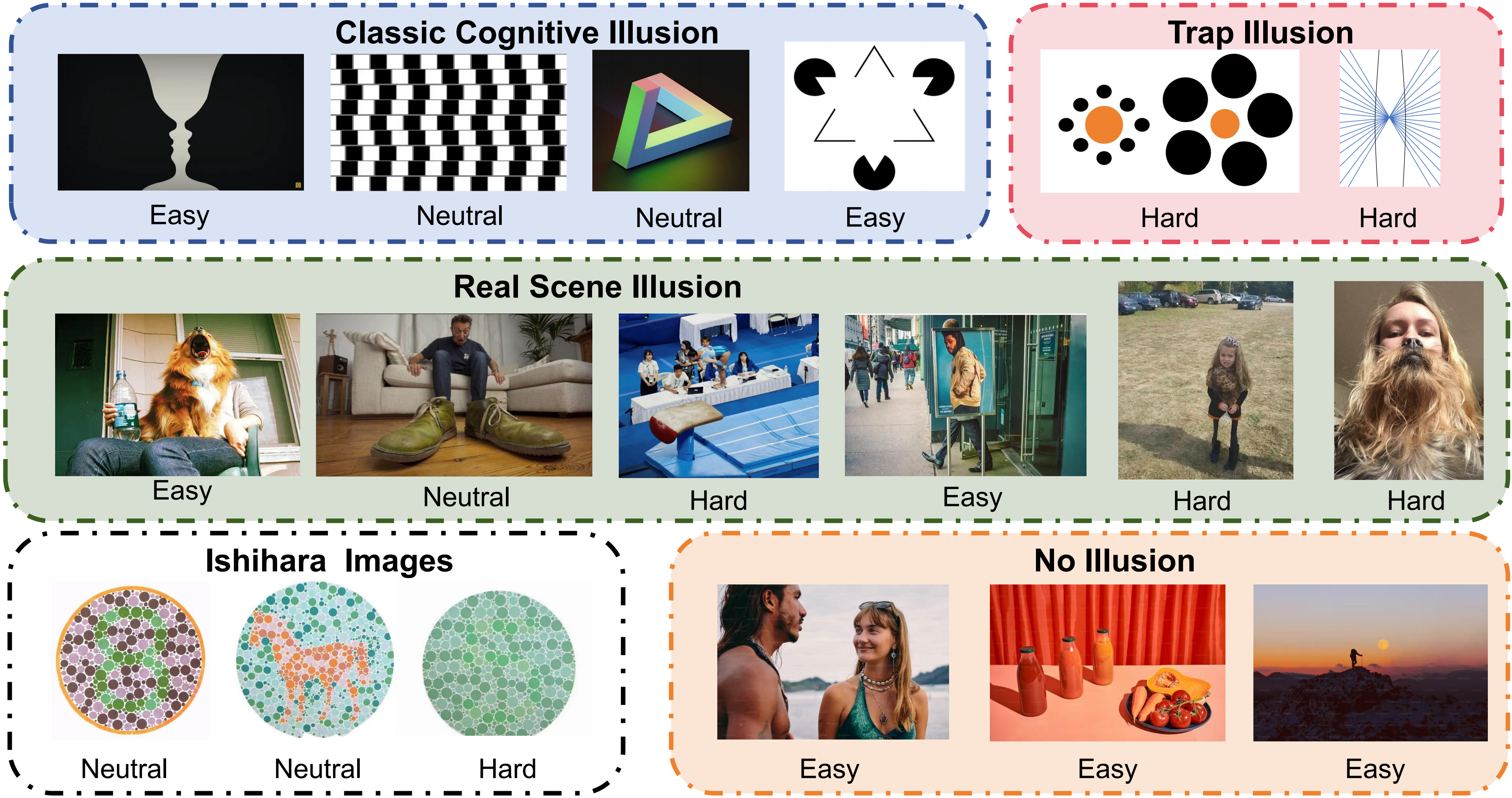
We introduce IllusionBench, the first benchmark designed to evaluate the capability of Vision-Language Models in understanding visual illusions.
IllusionBench is a large-scale visual illusion dataset, encompassing 1k+ images, 5k+ question-answer pairs, and 1k+ golden text descriptions, covering the presence, causes, and content of illusions.
We benchmark the performance of ten state-of-the-art VLMs on this dataset, evaluating their understanding of illusion images through true-or-false, multiple-choice, and open-ended descriptive tasks.
IllusionBench Construction
IllusionBench includes 1K+ images from various online repositories. The detailed distribution is shown below.
- Classic Cognitive Illusion: These include blur, distortion, paradox, and fictitious illusions—key examples of traditional synthetic illusions. Designed by psychologists, these ambiguous images test VLMs' alignment with human perception.
- Trap Illusion: Trap illusions are edited versions of classic visual illusions, resembling them in appearance but differing in physical properties.
- Real Scene Illusion: These images depict real-world objects and scenes, with unique and definite semantic descriptions.
- Ishihara Color Blindness Detection: Ishihara images, verified by vision-healthy individuals, where the patterns convey unique and definite semantics.
- No Illusion: Depicting diverse subjects such as people, landscapes, and objects.
IllusionBench including three question types:
- True-or-false: Over 2k binary questions focused on semantic content and the presence of illusions.
- Multiple-choice: Over 3k multiple-choice questions targeting fine-grained perception of image content and illusion causes.
- Open-ended Description: Each image is accompanied by a manually crafted golden description, covering the main content of the image, the existence of any visual illusion, and the causes of the illusion.
Glance at IllusionBench Performance

Evaluate your model on IllusionBench
Assume that you have download the IllusionBench
We provide a sample Closed_inference.py for testing Qwen-vl-max API format on IllusionBench true-or-false question
and multiple-choice question.
We provide a sample Opened_inference.py for testing Qwen-vl-max API format on IllusionBench semantic and illusion
description question.
You can modify the code to test your own model.
Contact
Please contact any of the first authors of this paper for queries.
- Yiming Zhang,
ming_zhang_sjtu@sjtu.edu.cn, Shanghai Jiao Tong University
- Downloads last month
- 59