Instructions to use mlabonne/gemma-3-4b-it-abliterated-v2 with libraries, inference providers, notebooks, and local apps. Follow these links to get started.
- Libraries
- Transformers
How to use mlabonne/gemma-3-4b-it-abliterated-v2 with Transformers:
# Use a pipeline as a high-level helper from transformers import pipeline pipe = pipeline("image-text-to-text", model="mlabonne/gemma-3-4b-it-abliterated-v2") messages = [ { "role": "user", "content": [ {"type": "image", "url": "https://huggingface.co/datasets/huggingface/documentation-images/resolve/main/p-blog/candy.JPG"}, {"type": "text", "text": "What animal is on the candy?"} ] }, ] pipe(text=messages)# Load model directly from transformers import AutoTokenizer, AutoModelForCausalLM tokenizer = AutoTokenizer.from_pretrained("mlabonne/gemma-3-4b-it-abliterated-v2") model = AutoModelForCausalLM.from_pretrained("mlabonne/gemma-3-4b-it-abliterated-v2") messages = [ { "role": "user", "content": [ {"type": "image", "url": "https://huggingface.co/datasets/huggingface/documentation-images/resolve/main/p-blog/candy.JPG"}, {"type": "text", "text": "What animal is on the candy?"} ] }, ] inputs = tokenizer.apply_chat_template( messages, add_generation_prompt=True, tokenize=True, return_dict=True, return_tensors="pt", ).to(model.device) outputs = model.generate(**inputs, max_new_tokens=40) print(tokenizer.decode(outputs[0][inputs["input_ids"].shape[-1]:])) - Notebooks
- Google Colab
- Kaggle
- Local Apps
- vLLM
How to use mlabonne/gemma-3-4b-it-abliterated-v2 with vLLM:
Install from pip and serve model
# Install vLLM from pip: pip install vllm # Start the vLLM server: vllm serve "mlabonne/gemma-3-4b-it-abliterated-v2" # Call the server using curl (OpenAI-compatible API): curl -X POST "http://localhost:8000/v1/chat/completions" \ -H "Content-Type: application/json" \ --data '{ "model": "mlabonne/gemma-3-4b-it-abliterated-v2", "messages": [ { "role": "user", "content": [ { "type": "text", "text": "Describe this image in one sentence." }, { "type": "image_url", "image_url": { "url": "https://cdn.britannica.com/61/93061-050-99147DCE/Statue-of-Liberty-Island-New-York-Bay.jpg" } } ] } ] }'Use Docker
docker model run hf.co/mlabonne/gemma-3-4b-it-abliterated-v2
- SGLang
How to use mlabonne/gemma-3-4b-it-abliterated-v2 with SGLang:
Install from pip and serve model
# Install SGLang from pip: pip install sglang # Start the SGLang server: python3 -m sglang.launch_server \ --model-path "mlabonne/gemma-3-4b-it-abliterated-v2" \ --host 0.0.0.0 \ --port 30000 # Call the server using curl (OpenAI-compatible API): curl -X POST "http://localhost:30000/v1/chat/completions" \ -H "Content-Type: application/json" \ --data '{ "model": "mlabonne/gemma-3-4b-it-abliterated-v2", "messages": [ { "role": "user", "content": [ { "type": "text", "text": "Describe this image in one sentence." }, { "type": "image_url", "image_url": { "url": "https://cdn.britannica.com/61/93061-050-99147DCE/Statue-of-Liberty-Island-New-York-Bay.jpg" } } ] } ] }'Use Docker images
docker run --gpus all \ --shm-size 32g \ -p 30000:30000 \ -v ~/.cache/huggingface:/root/.cache/huggingface \ --env "HF_TOKEN=<secret>" \ --ipc=host \ lmsysorg/sglang:latest \ python3 -m sglang.launch_server \ --model-path "mlabonne/gemma-3-4b-it-abliterated-v2" \ --host 0.0.0.0 \ --port 30000 # Call the server using curl (OpenAI-compatible API): curl -X POST "http://localhost:30000/v1/chat/completions" \ -H "Content-Type: application/json" \ --data '{ "model": "mlabonne/gemma-3-4b-it-abliterated-v2", "messages": [ { "role": "user", "content": [ { "type": "text", "text": "Describe this image in one sentence." }, { "type": "image_url", "image_url": { "url": "https://cdn.britannica.com/61/93061-050-99147DCE/Statue-of-Liberty-Island-New-York-Bay.jpg" } } ] } ] }' - Docker Model Runner
How to use mlabonne/gemma-3-4b-it-abliterated-v2 with Docker Model Runner:
docker model run hf.co/mlabonne/gemma-3-4b-it-abliterated-v2
💎 Gemma 3 4B IT Abliterated
This is an uncensored version of google/gemma-3-4b-it created with a new abliteration technique. See this article to know more about abliteration.
This is a new, improved version that targets refusals with enhanced accuracy.
I recommend using these generation parameters: temperature=1.0, top_k=64, top_p=0.95.
⚡️ Quantization
- QAT: https://huggingface.co/mlabonne/gemma-3-4b-it-qat-abliterated
- GGUF: https://huggingface.co/mlabonne/gemma-3-4b-it-abliterated-v2-GGUF
✂️ Abliteration
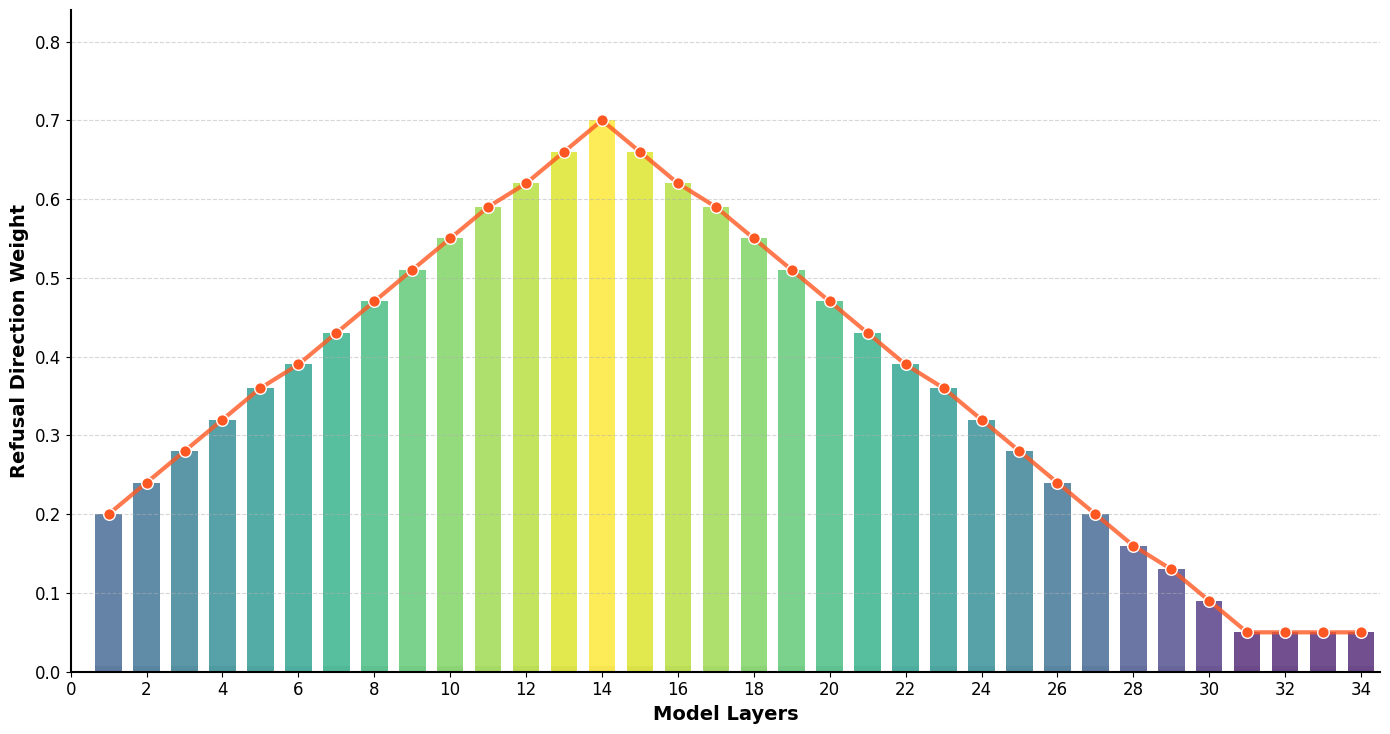
The refusal direction is computed by comparing the residual streams between target (harmful) and baseline (harmless) samples. The hidden states of target modules (e.g., o_proj) are orthogonalized to subtract this refusal direction with a given weight factor. These weight factors follow a normal distribution with a certain spread and peak layer. Modules can be iteratively orthogonalized in batches, or the refusal direction can be accumulated to save memory.
Finally, I used a hybrid evaluation with a dedicated test set to calculate the acceptance rate. This uses both a dictionary approach and NousResearch/Minos-v1. The goal is to obtain an acceptance rate >90% and still produce coherent outputs.
- Downloads last month
- 80